Job Skill Testing Website: The Complete Expert Blueprint to Build, Launch & Scale a High-Profit HRTech SaaS
In today’s hiring ecosystem, companies are done relying on assumptions, fancy resumes, and sugar-coated interviews. Skills need proof. Every HR team—from startups to enterprises—is aggressively shifting toward data-driven hiring, powered by online assessments. This is why the global Skill Assessment Platform market is exploding, with platforms like HackerRank, TestGorilla, Mercer Mettl, and iMocha becoming essential recruitment infrastructure.
If you want to build a Job Skill Testing Website that allows companies to test candidates through Aptitude, Coding, Marketing, and Domain-specific assessments—and monetize it through test credits and subscriptions—this is not just a business idea. It’s a powerful, scalable software product with massive B2B demand.
This expert blog breaks down the full process: technology, architecture, automation, monetization, growth frameworks, and strategic scaling.
1. Industry Insight: Why Skill Testing Platforms Are Booming
Before building, understand why companies buy such SaaS tools:
✔ Rising Hiring Volume, Declining Accuracy
Companies receive hundreds of applications—even for junior roles. HR teams need filtering mechanisms.
✔ Skill Gaps Are Real
Degrees no longer guarantee skill. Assessment validates real ability.
✔ Remote Hiring Demands Online Testing
Hybrid and remote hiring has made digital assessments mandatory.
✔ Automation Is Cheaper than Manual Evaluation
Auto-graded tests reduce HR effort significantly.
✔ Companies Prefer Pay-Per-Test Models
No long-term commitments; flexible and scalable.
This creates the perfect opportunity to build your Job Skill Testing SaaS—a high-margin, low-human-dependency platform.
2. Platform Vision: What Your Job Skill Testing Website Should Achieve
A successful Skill Testing Website must:
Help companies evaluate real skills quickly
Automate scoring, ranking, and filtering
Offer diverse test categories (Aptitude, Coding, Marketing, etc.)
Reduce manual HR workload
Deliver instant analytics and hiring insights
Scale to thousands of candidates simultaneously
Monetize through credits + subscriptions + enterprise plans
The business is powerful because once the product is built, it runs almost autonomously.
3. Core Functional Architecture (Expert-Level Breakdown)
Below is the architecture an enterprise-grade skill assessment platform must follow.
A. Employer (Recruiter) Dashboard
Key Modules
Test Creation Engine
Choose test category
Add custom questions
Set difficulty levels
Configure timer & question order
Enable randomization & anti-cheat settings
Candidate Management System
Bulk upload candidates
Send test invites
Track test progress (Not Started / In Progress / Completed)
Credits Management
Credits available
Credits consumed
Purchase credits
Auto-invoice generation
Results & Analytics
Individual report
Leaderboard
Skill-wise breakdown
Time spent analysis
Auto shortlisting
PDF export
Hiring Workflow Integration
Move shortlisted candidates to next round
Export to Google Sheets or ATS
Webhooks for HR tools
B. Candidate Testing System
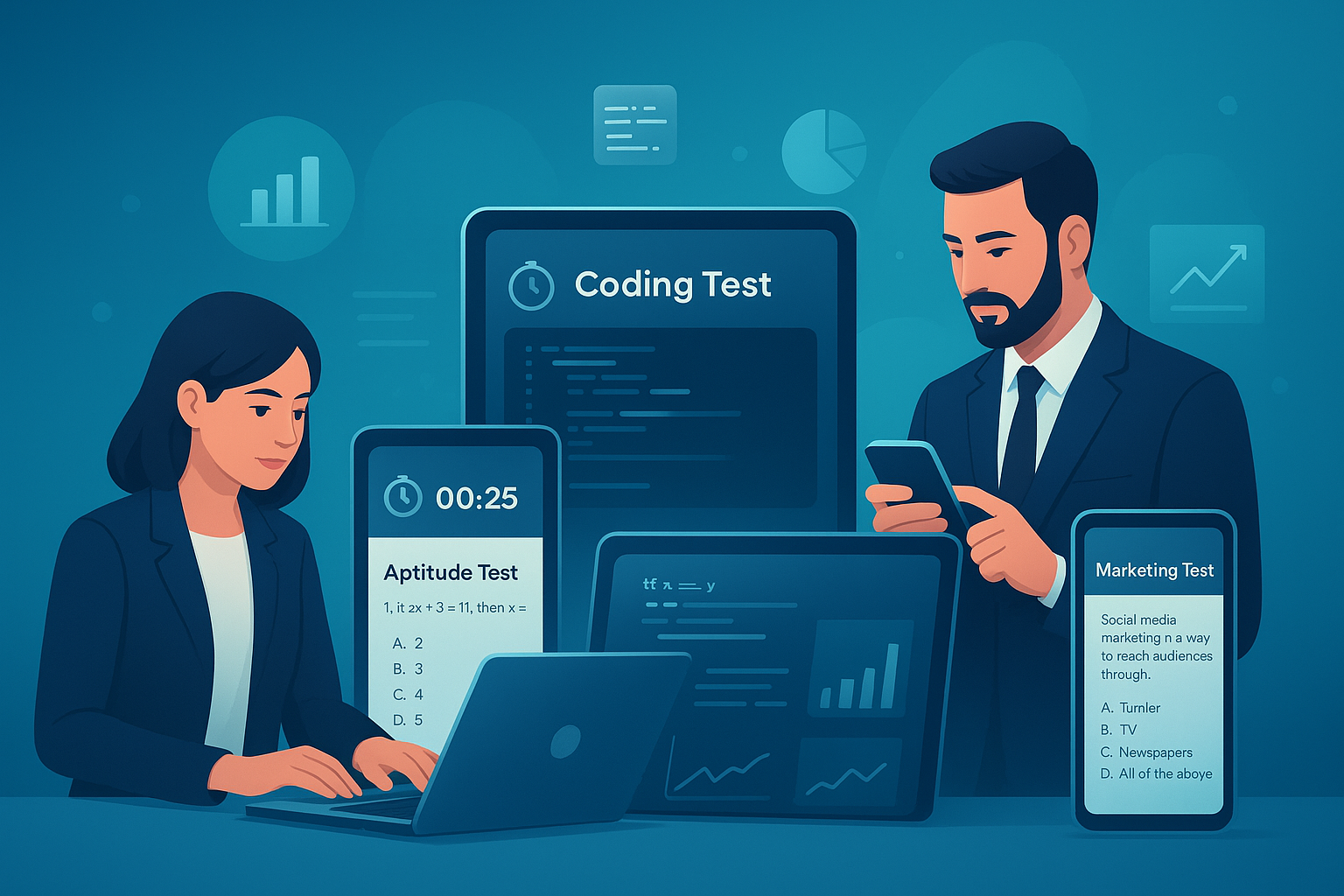
Aptitude Test
MCQs
Auto-evaluated
Timer-based
Coding Test
Online code editor (syntax highlighting)
Real-time code execution
Test cases scoring
Time complexity evaluation (advanced)
Supported languages: Python, C++, Java, JS, etc.
Marketing Test
SEO, Ads, Analytics, Strategy questions
Real-case scenario simulations (advanced)
Custom Tests
Any role
Company’s own questions
Weighted scoring
C. Evaluation Engine (Automation Layer)
This is the core intelligence of your platform.
Automatic Aptitude Evaluation
Picked from answer keys
Error logs
Time analysis
Automatic Coding Evaluation
Execute code inside a secure sandbox
Compare output with expected results
Evaluate hidden test cases
Check time/memory constraints
Assign auto scores
Marketing Test Evaluation
MCQs auto-checked
Scenario-based scoring (if added)
AI-Based Evaluation (Pro Feature)
Use AI to grade:
Essays
Case study answers
Marketing strategy plans
D. Anti-Cheating & Proctoring System
For an enterprise-grade system:
Tab-switch detection
IP tracking
Browser lockdown (optional)
Random question shuffling
Webcam proctoring (advanced paid feature)
E. Payment & Subscription Architecture
Test Credits Model
Employers buy credits:
1 credit = 1 candidate test attempt
Low friction
Great for small companies
Monthly Subscription
Basic → Limited tests
Pro → Larger test pool
Enterprise → Unlimited + custom features
Add-On Monetization
AI test generation
Video proctoring
Custom test creation
White-labeled system
Question bank packages
4. Technology Stack (Expert Recommended)
Frontend
React.js or Next.js
Tailwind CSS for UI speed
Chart.js for analytics
Backend
Node.js + Express
or
Python Django (excellent for enterprise systems)
Database
PostgreSQL (recommended)
Redis for caching test data
Code Execution Engine
Judge0 Open-Source API
Docker isolated execution
Infrastructure
AWS EC2 / Lambda
Cloudflare CDN
S3 for file storage
Security
JWT for auth
Encrypted test links
HTTPS enforcement
5. Step-by-Step Process of Building the Platform
Step 1: Build Core Features
Start with the essentials:
MCQ tests
Coding tests
Auto-evaluation
Candidate dashboard
Step 2: Integrate Test Categories
Add:
Aptitude
Coding
Marketing
Add more categories gradually:
HR
Finance
Sales
Behavioural profiling
Step 3: Build the Test Engine
This includes:
Timer
Autosave
Randomization
Answer locking
Step 4: Develop the Evaluation Logic
Make sure results are:
Immediate
Accurate
Insightful
Step 5: Build Reports + Insights
This is where companies see real value:
Score graphs
Accuracy rate
Time taken per question
Coding result comparison
Ranking
Step 6: Implement Payments
Razorpay for India
Stripe for global
Step 7: Add Marketing Website + Landing Pages
Explain:
Features
Pricing
Sample reports
Demo video
Step 8: Testing & QA
Very important for edge cases:
Slow internet
Random tab switches
Code execution failures
Step 9: Launch MVP
Release with:
3 test categories
30–50 sample questions
Credits for companies
Step 10: Scale
Add:
AI test generator
Proctoring
API integrations
6. Revenue Model: How You Make Money Every Month
Primary Income Sources
Test Credits (High Margin)
Monthly/Yearly Subscriptions
Enterprise Licensing
White-Label Platform for HR Agencies
Premium Test Banks (Marketing, Aptitude, Coding)
AI-powered evaluation tools
High-Profit Opportunities
Sell 10,000 test credits to corporate HR?
Profit = 95–98%
Offer white-label version to HR consultancy?
Profit = recurring licensing
This is a SaaS business with massive scalability.
7. Marketing Strategy: How to Get Paying Companies
1. LinkedIn Direct Outreach
DM HR heads, talent acquisition leads, and founders.
2. SEO Blogs
Write blogs like:
“Best tool to test coding skills before hiring”
“How to filter candidates using aptitude tests”
“Top skill assessment tools for startups”
Organically brings HR teams.
3. Free Credits Offer
“Get 20 free candidate tests when you sign up”
This converts exceptionally well.
4. Email Campaigns to Startups
Provide:
Demo
Free test report example
5. Partnerships with HR Agencies
Give them a white-label version.
6. College Recruitment Tie-ups
Sell bulk test packages.
8. Scaling Roadmap (Expert Version)
Stage 1: MVP (0–3 months)
Aptitude + Coding + Marketing tests
Basic dashboard
Credit system
Core reports
Stage 2: Growth (3–9 months)
AI question generation
Behavioural assessments
Video proctoring
Candidate identity verification
Admin analytics dashboard
Stage 3: Enterprise Level (9–18 months)
Multi-user company accounts
ATS integrations
Company-specific custom test libraries
AI-driven hiring recommendations
This is how your platform grows into a world-class HRTech product.
Conclusion
A Job Skill Testing Website is one of the most powerful SaaS products you can build today. It solves a universal hiring problem, delivers automation, saves HR hours, and offers recurring revenue through credits and subscriptions.
With the right architecture, technology stack, anti-cheat features, AI evaluation, and enterprise-grade analytics, this business can scale to thousands of companies worldwide.
If you want, I can also create:
✅ 4000-word expanded expert version
✅ Landing page content + UI structure
✅ Pricing packages with conversion psychology
✅ Test categories & question bank design
✅ Marketing copy + ad creatives
✅ A complete business pitch deck for investors