
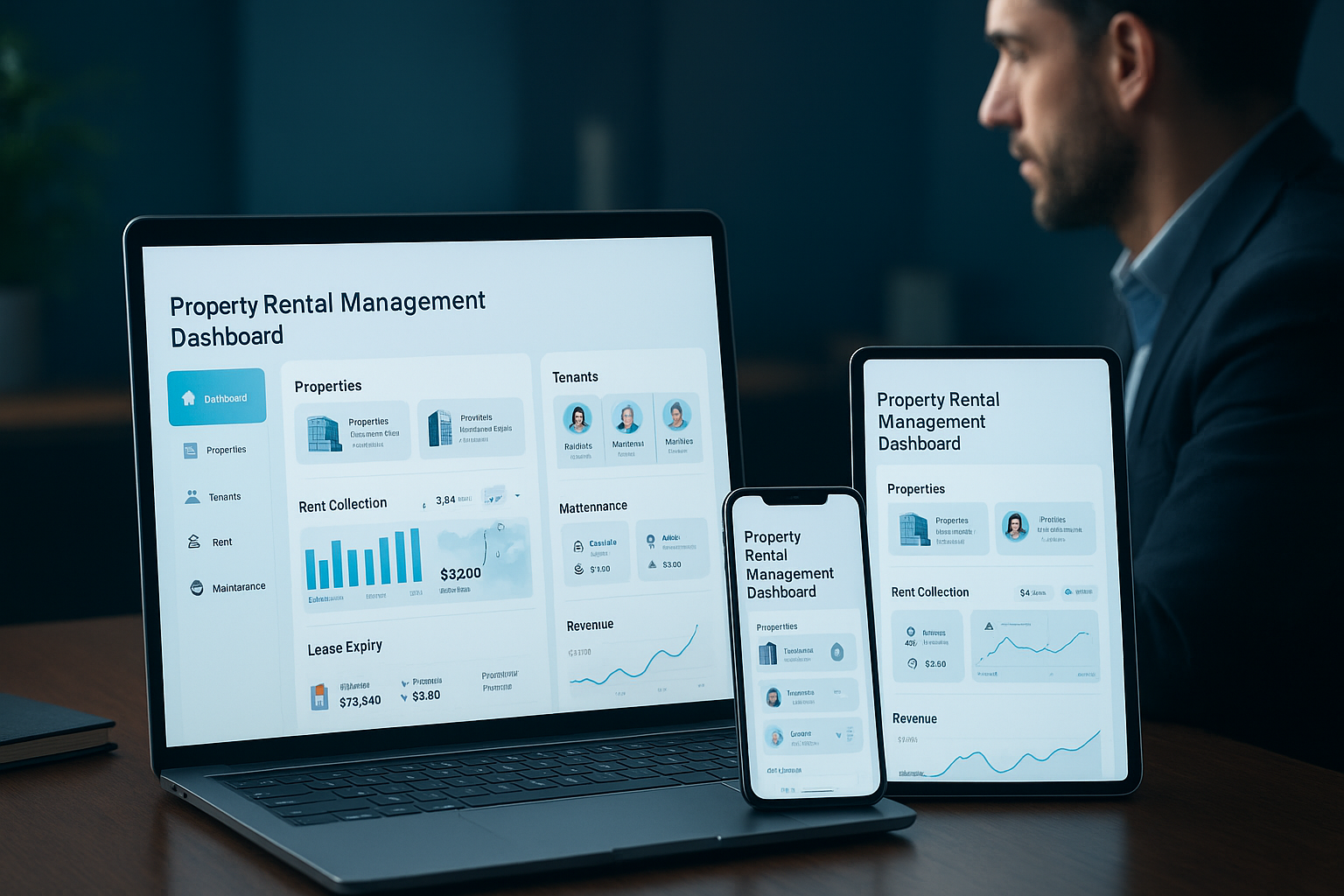
Why a “Property Rental Management Dashboard”?
Managing rental properties is rarely simple. Owners or agencies juggling multiple properties often struggle with manual spreadsheets, late rent payments, maintenance chaos, lease renewals, poor tenant communication — all of which cause inefficiency, tenant dissatisfaction, and revenue leakages. whatmaction.com+2RentalReady+2
A well-built dashboard / software can centralize and automate all property-management tasks — from rent collection to maintenance tracking to analytics — offering transparency, control, and scalability. Infintor Solutions+2leasey.ai+2
With rising demand for digital property-management solutions globally (and in markets like India), you have a real opportunity to build something valuable. Ken Research+2https://dwello.in+2
The Detailed Process: From Idea to Execution
1. Validate the Market & Define Your Niche
Begin by researching the local / regional rental-property market. Consider:
Are you targeting owners with only a few units (small landlords), or larger property managers handling dozens/hundreds of units?
What pain points are most severe: rent collection delays, maintenance backlog, lease renewals, tenant communication, document tracking…?
In regions like India, many smaller landlords still manage properties manually — which means high latent demand for simple, easy-to-use property-management tools. Ken Research+2RentOk+2
Based on this, decide your initial target segment. For example: independent landlords with 2–10 units, or small rental-management agencies.
Also, scope out competition (local software, global SaaS, informal spreadsheet-based management) — and find your differentiation (simplicity, affordability, localization, mobile + banking features, legal templates, tenant-friendly UI, etc.).
2. Define Core Features & MVP Scope
Based on what property-management software users need, a Minimum Viable Product (MVP) dashboard should include: Software Advice+2Infintor Solutions+2
Property database: Store each property’s details (address, type — flat/shop/house, size, amenities, photos, etc.). Software Advice+1
Tenant & lease management: Track tenants, lease start/end dates, lease agreements, renewals. Automated reminders for lease expirations or renewals add value. Infintor Solutions+1
Rent collection & financial module: Generate rent invoices, send reminders, record payments, track due and overdue payments. This helps maintain stable cash flow. RentalReady+2leasey.ai+2
Maintenance / service request module: Let tenants submit maintenance requests (with optional images), track status, assign to vendors — easier coordination and faster resolution. Software Advice+2Infintor Solutions+2
Tenant portal + communication features: Tenants should be able to view lease, receipts, request maintenance, pay rent, communicate with landlord — all within the system. Improves tenant satisfaction. Software Advice+2RentalReady+2
Dashboard & analytics: Show occupancy rates, revenue, overdue payments, maintenance backlog, lease expiry calendar, cash flow — to give landlords/property managers a quick overview. Hoozzee+2Infintor Solutions+2
Document management: Store lease agreements, tenant ID copies, receipts, maintenance invoices, property photos — digital, searchable, secure. Infintor Solutions+1
For MVP, start with the essentials (property database + tenant/lease + rent collection + tenant portal + basic dashboard). Advanced features (vendor-management, analytics, integrations) can come later.
3. Choose Technology Stack & Architecture
Since you expect multiple users (owners, tenants, property managers), roles, real-time updates and maybe mobile access — building a cloud-based web app + mobile-responsive design (or standalone mobile apps later) makes sense.
Backend: Could use a modern web-stack (e.g. Node.js / Python / Java + relational database) to store property, tenant, lease, payment and maintenance data.
Frontend: Responsive web UI / dashboard + potentially separate tenant-portal UI.
Optional future: Add push notifications / email reminders, payment gateway integration, document upload + storage, reporting engine.
Security & data privacy: Since you’ll handle sensitive tenant and financial data, implement secure authentication, role-based access, encryption, backups. Especially important given privacy and security concerns in digital property-management in India. Ken Research+1
Scalability: Design to support from a handful of properties to hundreds — so modular code, cloud-hosting (or container-based), and efficient database design is key.
4. Design UX & UI — Make It Intuitive
A major draw for clients is ease of use. A cluttered or complicated interface will defeat the purpose. As highlighted by property-management software guides, intuitive dashboards and customizable widgets are key for user adoption. Haletale+2leasey.ai+2
Design the user-journey from the landlord/manager’s POV and tenant’s POV:
Landlord/manager dashboard home: “At a glance” — upcoming rent due, overdue payments, lease expirations, maintenance tickets, summary revenue.
Tenant portal: Clear menu: pay rent / view receipts / submit maintenance request / view lease / contact manager.
Forms & inputs: Simple, minimal, avoid overload.
If starting small, even a clean web dashboard + mobile-responsive front-end can be enough. Later, consider native mobile apps if user demand grows.
5. Build MVP & Pilot with Real Users
Once MVP is ready:
Onboard a small group of landlords/property owners (friends, acquaintances, small portfolio owners) to pilot test.
Collect feedback: usability, missing features, pain points. Refine UI/UX and fix bugs.
Possibly onboard a couple of tenants too (if you manage the property) to test tenant-portal features: rent payment flow, maintenance requests, document uploads.
This pilot helps you validate the product-market fit before a full-scale launch.
6. Define Business Model & Revenue Streams
Decide how you'll monetize the platform. Some options:
Subscription model: Monthly / annual fee per property or per “property manager account”. For example, a small landlord pays a fixed small fee for up to N units; larger agencies pay more.
Freemium + premium features: Basic features free or low-cost; premium features (analytics, advanced reports, vendor-management, multi-role access, integrations) behind paywall.
Percentage of rent collected (as service fee): If you facilitate online rent collection — like escrow or payment gateway — you could take a small percentage fee. (But this involves regulatory/financial complexities.)
Onboarding / setup fee: For initial property and tenant data import, lease document digitization, etc.
Also consider offering value-added services later: vendor coordination (maintenance services), property inspections, legal/lease-document templates, tenant background checks — could become additional revenue streams.
7. Compliance, Security & Data Protection
Given sensitivity of tenant data, financial records, leases — you must ensure compliance with local laws/regulations (data privacy, tenancy laws, record-keeping).
Build secure authentication, role-based access, encrypted data storage.
Regular backup and disaster-recovery.
Optionally, build audit logs (who did what, when) — good for landlords, helps in disputes.
Maintain transparency: ensure tenants and landlords understand what data is stored, how it's used, and consent is obtained.
This reduces legal risk and builds trust — a key competitive advantage, especially in markets wary of digital systems. Ken Research+1
8. Launch: Go-to-Market Strategy
Once the product is stable and pilot validated, plan your launch:
Targeted outreach: Reach out to small landlords, real-estate agents, rental agencies in your region — many still rely on spreadsheets/manually — your dashboard offers value.
Offer demo & free trial: Let potential clients test the product risk-free. Demonstration of benefits — like reduced paperwork, clear cash flow visibility — will help convert.
Leverage digital marketing: Use online ads, local real-estate groups/social media, content marketing (blogs, case studies) to build awareness. Given your background in digital marketing (like your interest in Zixin India), you can leverage those skills to promote.
Referral / affiliate programs: Encourage users to refer landlords/neighbors and offer discounts or perks for referrals.
Feedback loop & customer support: Ensure you have a responsive support system. Early users need hand-holding; quick support builds trust and loyalty.
9. Expand Features & Ecosystem (Next Phases)
Once you get initial traction, you can evolve the product with advanced features:
Analytics & business-intelligence dashboard: Show occupancy trends, rental yield, cash flow forecasting, maintenance costs vs income — help landlords/investors make data-driven decisions. Hoozzee+1
Smart home / IoT integrations: For tenant experience — integrate with smart locks, thermostats, security systems for remote monitoring/control (if feasible). This adds value, especially for premium properties. RentPost+1
Vendor / maintenance ecosystem: Maintain list of trusted vendors (electric, plumbing, cleaning), allow booking & tracking via dashboard — a value-add service.
Tenant screening / background check integration: If you help with tenant onboarding, offer identity verification, background checks (where legal) — increases trust.
Multiple property-owner / manager roles: For agencies managing many landlords — ability to manage multiple portfolios, assign sub-managers, role-based permissions.
Integration with accounting, taxation tools: For landlords who want auto-expense tracking, tax-ready reports, expense vs income overview. leasey.ai+1
Mobile apps: Native Android/iOS apps for landlords and tenants for better UX, push notifications.
10. Operations, Support & Scaling
As user base grows:
Build reliable infrastructure — cloud hosting, scalable database, efficient back-ups.
Maintain 24/7 support or at least timely support (important for tenants).
Regular updates — security patches, feature enhancements, UI improvements.
Data analytics for user behavior — understand what features are used, where friction points are, and iterate.
Consider expanding to other cities/states — but adapt to local rental laws, language preferences, payment methods.
Challenges & How to Tackle Them
Low digital literacy among some landlords / tenants: Many may prefer traditional methods (cash, cheque, paperwork). → Mitigate by offering simple, intuitive UI; possibly onboarding support; tutorial videos; phone support. Ken Research+1
Data privacy concerns: Tenants may worry about sharing documents online. → Provide clear privacy policy, data encryption, reassure about security and limited access.
Payment gateway / banking integration complications (especially in India): Online payments need banking support, trust, compliance — may involve regulatory overhead. → Initially, allow manual/rent collection logging as optional; later as trust builds, add online payments.
Market resistance / inertia: Landlords used to spreadsheets or brokers may resist change. → Use demos, success stories, highlight time/money saved, stress transparency and efficiency.
Scaling complexity: As portfolio grows, the complexity increases — maintenance schedules, multiple properties, multiple tenants / vendors. → Build robust architecture, modular code, efficient scheduling and notification systems.
Why Now is a Good Time — Market Trends & Opportunity
The property-management software market is growing rapidly, with demand for cloud-based, mobile-accessible solutions increasing globally. Market Research Intellect+2RentPost+2
Many landlords and agencies — especially in emerging economies — are still using manual processes or spreadsheets, indicating large untapped potential. whatmaction.com+2https://dwello.in+2
Tenants increasingly expect convenience: online rent payment, easy maintenance request reporting, digitized lease documents, transparent communication. Digital dashboards and portals satisfy these demands and improve tenant retention. Software Advice+2CRE+2
With growth in remote work, mobility, and investors owning properties across cities, a centralized, cloud-based dashboard becomes more valuable — landlords/owners can manage remotely from anywhere.
Final Thoughts: Your Unique Value & Vision
Your idea — the Property Rental Management Dashboard — can fill a pressing need: streamlining and modernizing property rental operations. If you execute with a focus on simplicity, reliability, and user-friendliness, you can lower the barrier for landlords (especially small / medium) to adopt digital property management.
With thoughtful design, robust backend and a strong go-to-market plan, this could evolve into a full-fledged “prop-tech” platform — helping landlords, tenants, and property managers connect, transact and manage efficiently.