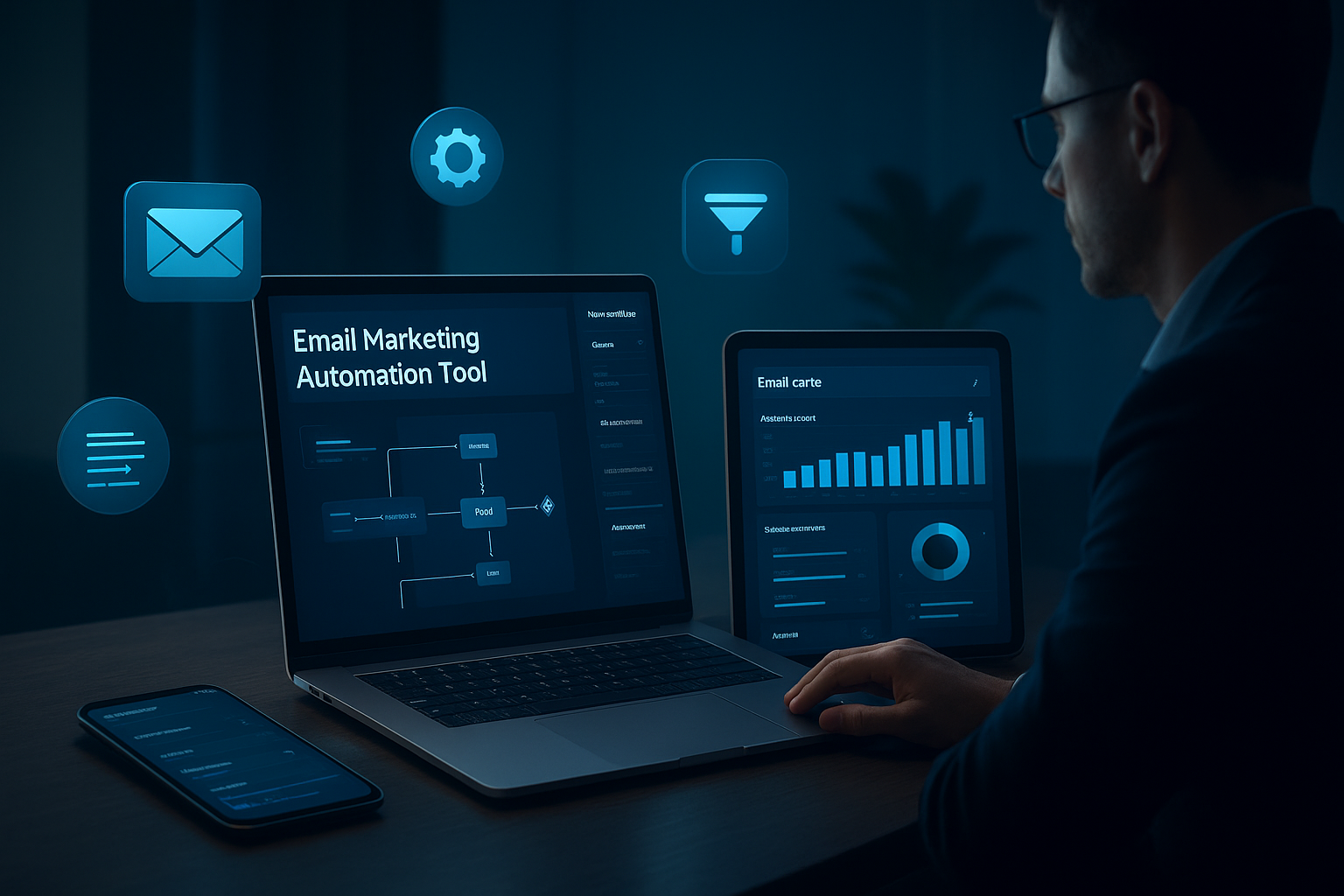
Email Marketing Automation Tools: The Silent Growth Engine Behind Modern Businesses
In a digital world overflowing with notifications, ads, and fleeting social media content, email remains the one channel that consistently delivers measurable, predictable business results. Yet, it’s not email alone that drives conversions — it’s automated email marketing that transforms casual subscribers into loyal buyers, dormant leads into sales-ready prospects, and existing customers into lifelong brand advocates.
This is why Email Marketing Automation Tools have become one of the most powerful pieces of a company’s digital growth stack. They simplify complex workflows, save hundreds of manual working hours, and bring precision, personalization, and timing to every customer interaction.
Today, email automation isn’t just a marketing feature — it’s a complete business system. Let’s explore how it works, why it matters, and how modern brands are using it to accelerate growth.
Why Email Automation Matters More Than Ever
Most businesses send emails.
Very few send the right emails.
Automation bridges this gap.
Unlike manual campaigns—where emails are sent in bulk with limited targeting—automation tools allow brands to communicate with customers based on behavior, timing, need, and intent.
Real Impact of Email Automation (Industry Stats)
Automated emails generate 320% more revenue than non-automated ones.
Behaviour-based emails see up to 8X higher engagement.
Companies using automation experience 53% higher conversion rates.
75% of marketers say email automation saves them more than 6 hours per week.
This isn’t just technology.
It’s a growth catalyst.
What Exactly is an Email Marketing Automation Tool?
An email marketing automation tool is a software that allows businesses to send smart, personalized, trigger-based emails automatically — without manually pressing the send button.
Instead of a marketer thinking “What email should I send next?” the system decides based on:
What a user does
What a user needs
Where a user is in their buying journey
Examples of Automated Email Triggers
User signs up → send welcome series
User adds to cart → send cart recovery email
User doesn’t open emails → send re-engagement sequence
User buys → send thank you + upsell emails
Subscription expiring → send renewal reminder
Customer inactive → send win-back campaigns
Automation elevates email from a messaging channel to a customer lifecycle experience platform.
Core Features of an Email Marketing Automation Tool
A truly powerful automation platform includes:
1. Drip Campaigns
A predefined sequence of emails automatically sent over time — nurturing prospects from awareness to decision.
Example:
Day 1 – Thank you for signing up
Day 3 – Value email
Day 5 – Case study
Day 7 – Offer or call-to-action
2. Behavior-Based Triggers
Emails sent based on specific user actions.
If the user clicks a pricing page, the system might send a product comparison email.
This makes email relevant, not spammy.
3. Segmentation & Personalization
Advanced filtering based on:
Age
Industry
Previous purchases
Engagement history
Location
Browsing behavior
Personalized emails increase conversions by over 45%.
4. Dynamic Content Blocks
One email changes content automatically depending on the subscriber.
Example:
A clothing brand shows men’s products to male subscribers, women’s products to female subscribers — in a single automated template.
5. A/B Testing
Helps brands test:
Subject lines
Call-to-action text
Content layout
Send timings
This ensures every email is optimized for conversions.
6. Advanced Analytics
Insights into:
Open rate
CTR
Conversion rate
Bounce rate
Revenue generated
Brands can measure which email is driving actual business impact.
7. Integrations
Automation tools connect with:
CRM
E-commerce systems
Website forms
Payment gateways
Landing pages
SMS systems
This creates a unified marketing ecosystem.
How Email Automation Helps Businesses Grow
1. Saves Time & Human Effort
Once a workflow is created, the system runs forever with zero manual intervention.
A marketing team that once needed 10 hours a week for emails now needs 30 minutes.
2. Converts Leads Faster
Automation nurtures leads throughout their buying journey with:
Value-driven emails
Case studies
Offers
Follow-ups
Result:
Higher conversions, fewer lost leads.
3. Strengthens Customer Relationships
Automated email flows keep the brand present and helpful — not annoying.
Customers feel cared for, not marketed to.
4. Boosts Revenue Consistently
Abandoned cart emails alone recover up to 20–25% of potential lost sales.
Upsell and cross-sell automation increases basket size automatically.
5. Improves Customer Retention
Re-engagement and win-back email flows ensure lost users come back.
Renewal reminders improve subscription retention.
Real-World Examples of Email Automation in Action
E-commerce Example
A user adds a product to cart → doesn’t checkout
The tool sends:
30 minutes later – Reminder
24 hours later – Product benefits
48 hours later – Limited discount
This sequence increases chances of recovery by 3X.
SaaS (Software) Example
A user starts a free trial.
Automation sends:
Day 1 – Welcome & tutorial
Day 3 – Feature highlight
Day 6 – Case study
Day 10 – Upgrade reminder
Result: Higher trial-to-paid conversion.
Service Business Example
A user fills a consultation form.
Automation sends:
Immediate – Confirmation
After 2 hours – Intro of company
After 1 day – Testimonials
After 3 days – Offer + CTA
Lead nurturing becomes effortless.
Most Popular Email Automation Tools Today
Here are widely used platforms across industries:
Mailchimp
HubSpot
ActiveCampaign
Klaviyo
SendinBlue
ConvertKit
Drip
Zoho Campaigns
Each offers:
Automation builder
Drip sequences
Segmentation
Templates
Analytics
How to Choose the Right Email Automation Tool
1. Define your goals
Lead nurturing? E-commerce automation? Newsletters?
2. Check integration compatibility
Does it connect to your CRM, website, or app?
3. Evaluate automation builder
Is it drag-and-drop? Easy to use?
4. Consider pricing & scalability
Start small but ensure you can scale later.
5. Look for analytics
Without data, optimization is impossible.
Future Trends in Email Automation
The next level of email automation includes:
1. Hyper-Personalization with AI
Emails that adapt based on user behaviour in real-time.
2. Predictive Automation
AI guesses what the user is likely to do next.
3. Smart Send-Time Optimization
Emails sent at the exact time a user is most active.
4. Interactive Emails
Forms, surveys, carousels inside the email.
5. Full Omnichannel Automation
Email + SMS + WhatsApp + Push notifications.
Conclusion: Email Automation Is No Longer a Luxury — It’s a Necessity
Businesses that rely on manual email marketing fall behind quickly.
Those that adopt automation gain:
Higher conversions
Better customer relationships
Stable revenue growth
Efficient marketing operations
An Email Marketing Automation Tool doesn’t just send emails — it builds an intelligent, predictable, scalable system that works 24/7.
It is one of the most powerful growth engines your business can adopt.