
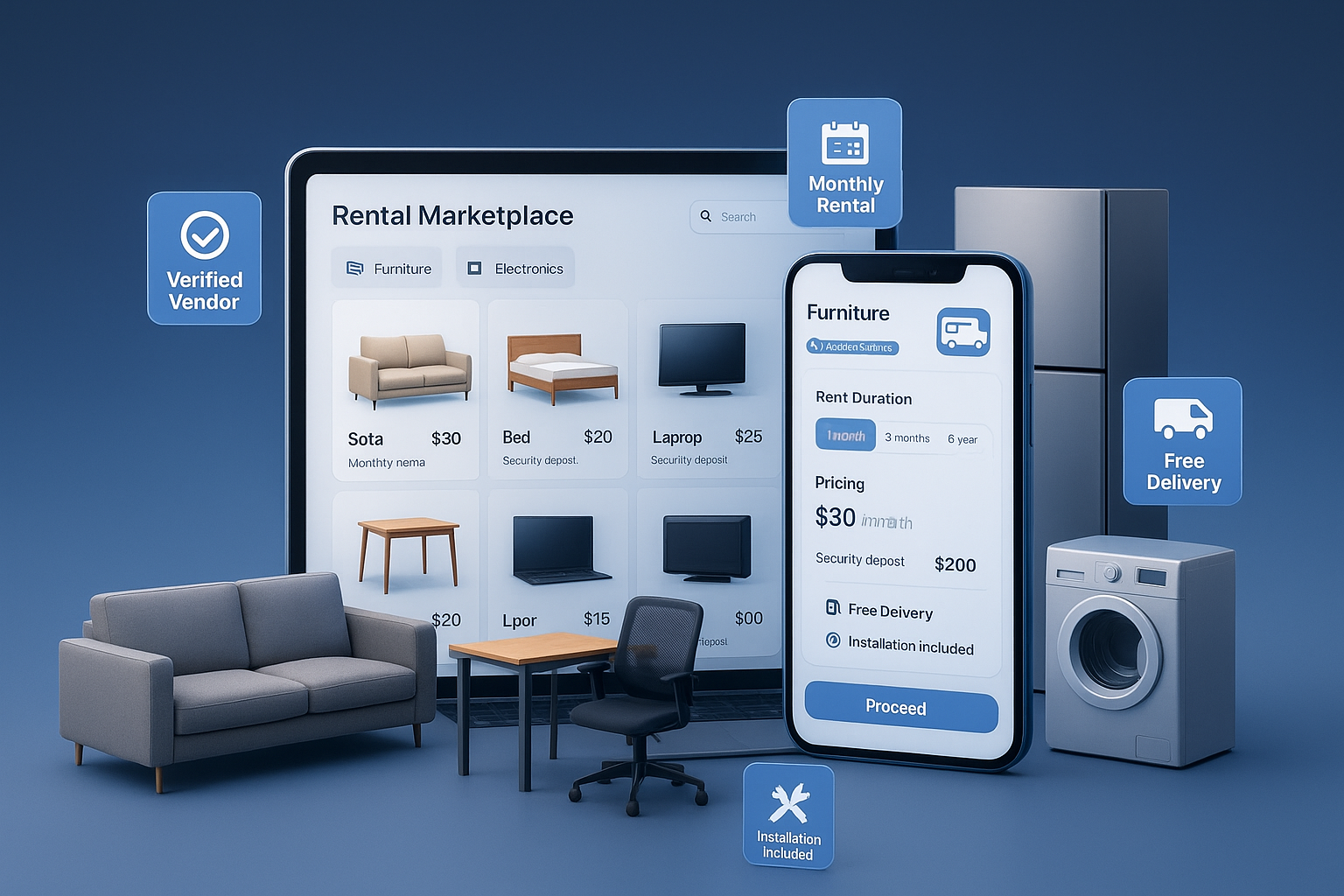
🏠📦 How to Build a Rental Marketplace for Furniture & Electronics: An Expert-Level Guide (2025 Edition)
The rental economy has shifted from a convenience-driven service to a full-fledged business ecosystem valued at over $9+ billion globally. Urban migration, flexible lifestyles, and rising living costs have paved the way for platforms that allow consumers to rent everything they need — from sofas and laptops to refrigerators and office workstations.
A Rental Marketplace for Furniture & Electronics is one of the most scalable, profitable, and recurring-revenue business models in 2025. In this expert guide, we break down every layer: market insights, operational workflow, technology architecture, features, monetization, and a complete development roadmap.
📊 1. Market Overview & Business Potential
✔ Why this business works:
Shift to asset-light lifestyle (especially among students, working professionals, and tenants).
High urban mobility → Renting preferred over buying.
Increasing demand for work-from-home setups (office chairs, laptops, desks).
Rising cost of electronics → Renting becomes affordable.
✔ Categories with highest rental demand:
Living room & bedroom furniture
Laptops and desktops
AC, refrigerator, washing machine
Smart TVs
Office chairs & desks
Fitness equipment (treadmills, cycles)
✔ Biggest Players:
Furlenco, Rentomojo, CityFurnish, QuikrBazaar, Ferns & Petals Rentals (growing category).
This market has low competition in Tier 2–3 cities, making it a strong opportunity for new startups.
🔄 2. How the Rental Marketplace Works: End-to-End Workflow
A rental marketplace operates on a mix of subscription, deposit, and logistics-heavy workflows. This makes the backend architecture more complex than a normal eCommerce site.
Step 1: Vendor Product Onboarding
Vendors upload product details and images.
Define condition: brand new / refurbished / used.
Set deposit, monthly rental rate, minimum tenure.
Inventory quantity (single unit or bulk).
Step 2: Customer Browsing & Selection
Customers explore through:
AI-powered product recommendations
Filters (rent price, tenure, brand, color, condition)
360° photos, AR previews
Comparison of rental packages
Step 3: Rental Tenure & Deposit Selection
Key components:
Monthly rental fees
One-time security deposit
Add-on services (cleaning, maintenance, upgrade option)
Step 4: KYC & Customer Verification
This step reduces rental fraud:
Aadhaar / PAN validation
Address verification
Workplace verification
Digital rental agreement + e-sign
Step 5: Delivery, Setup & Installation
The platform manages logistics:
Warehouse pickup
Delivery partner assignment
Home installation (furniture, electronics)
Real-time delivery tracking
Post-delivery quality check
Step 6: Billing & Subscription
Auto-renewal every month
Late fee automation
Damage + penalty calculation
Payment reminders via SMS/Email/WhatsApp
Step 7: End-of-Rental Lifecycle
Customer chooses:
Return
Extend
Upgrade
Purchase at residual value
Exchange with another product
Returned items go through:
Damage inspection
Cleaning/refurbishment
Repackaging
Added back to inventory
🧰 3. Core Features: Buyers, Vendors & Admin
🔹 Customer Features (Frontend)
Advanced search + dynamic filters
Product carousel, 360° view, video demos
Rental duration selector
Deposit estimator
Delivery date selector
KYC onboarding
Subscription billing
Damage protection add-on
Order tracking
🔹 Vendor Features
Inventory dashboard
Rental history tracking
Real-time product availability
Pricing engine (dynamic rent suggestions)
Return & damage claims
Earnings report
Payout system
🔹 Admin Features
Vendor verification
Inventory lifecycle management
Rental contract automation
KYC/document review panel
Refund & deposit management
Damage & penalty calculator
Advanced billing engine
City-wise logistic routing
Multi-warehouse management
AI-based fraud detection
Reporting & analytics (inventory ROI, utilization)
🧩 4. Operational Challenges & How to Solve Them (Expert View)
✔ 1. Inventory damage
Solve via:
Damage protection plan
Security deposit
Smart IoT tags for expensive appliances
✔ 2. Logistics & reverse logistics
Solve via:
Automated delivery routing
Partner integrations (Delhivery, Dunzo, Porter)
Warehouse zoning (north/south/west hubs)
✔ 3. Inventory ROI optimization
Use:
AI-powered pricing
Product lifecycle tracking
Predictive maintenance
Refurbishment grading system
✔ 4. Fraud prevention
Tools:
KYC APIs
Employment verification
Address proof + digital agreement
AI risk scoring
🧱 5. Technology Stack (Enterprise-Level)
🖥 Frontend
Next.js / React
Vue / Nuxt
Flutter for mobile apps
⚙️ Backend
Node.js with Express / NestJS
Django + DRF
Laravel (for fast MVPs)
🗄 Database
PostgreSQL / MySQL (structured data)
MongoDB (flexible product specs)
📦 Cloud & DevOps
AWS / Google Cloud
S3 for images & videos
Load balancer + auto-scaling
CI/CD pipelines (GitHub Actions)
🔌 Integrations
Razorpay/Stripe/Cashfree subscription billing
KYC APIs
SMS/Email gateways
WhatsApp Business API
Delivery API (Shiprocket/Delhivery)
💰 6. Revenue Model: Multi-Layered Income Streams
1. Monthly Rental Commission
10–30% per rental cycle.
2. Vendor Subscription Plans
Basic, Standard, Premium (₹999/₹1999/₹4999 per month).
3. Security Deposit Handling Fee
5–10%.
4. Delivery & Installation Charges
Or free for premium customers.
5. Add-on Services
Damage protection
Cleaning
Upgrade plan
6. Refurbished Item Sales
After lifecycle completion, sell used products at 40–60% margin.
7. Corporate Rentals
Special plans for:
Startups
Offices
Co-working spaces
Hostels/Paying Guests
🚀 7. Step-by-Step Development Process (Full Roadmap)
Step 1: Market Analysis & Business Model
Target city (Tier 1, 2, or 3?)
Choose niche: Furniture only? Electronics only? Hybrid model?
Logistics strategy
Step 2: UI/UX Wireframing
Home page
Product detail page
Rental cart
KYC flow
Vendor dashboard
Admin panel
Step 3: Backend Architecture
Role-based access
Inventory management
Subscription billing
Rental lifecycle engine
Auto-pricing logic
Notification system
Step 4: Vendor & Inventory System
Vendor login
Bulk uploads
Inventory lifecycle (new → rented → returned → refurbished → rented again)
Step 5: Logistics & Delivery Module
Delivery routing
Partner API integration
Warehouse entity management
Return pickup workflows
Step 6: KYC + Security Module
Document upload
OCR validation
Fraud detection engine
Contract generator
Step 7: Launch Strategy
Founders-led onboarding of first vendors
Local influencer marketing
Target ads for PG residents & corporate clusters
SEO: “rent furniture in <city>” pages
Student offer plans (big conversion source)
Step 8: Scaling Strategy
Launch multiple cities
Add subscription memberships
Offer B2B rental plans
Integrate AI: price suggestions, demand forecasting
Add app in Play Store & App Store
🏁 Conclusion
A Rental Marketplace for Furniture & Electronics is a high-ROI, high-demand, subscription-driven business. With the right combination of technology, logistics, and product lifecycle management, you can build a scalable platform like Rentomojo or Furlenco, or even outperform them in Tier 2–3 cities.
This business offers predictable recurring revenue, asset reusability, and multi-layered monetization, making it one of the most profitable digital ventures today.