
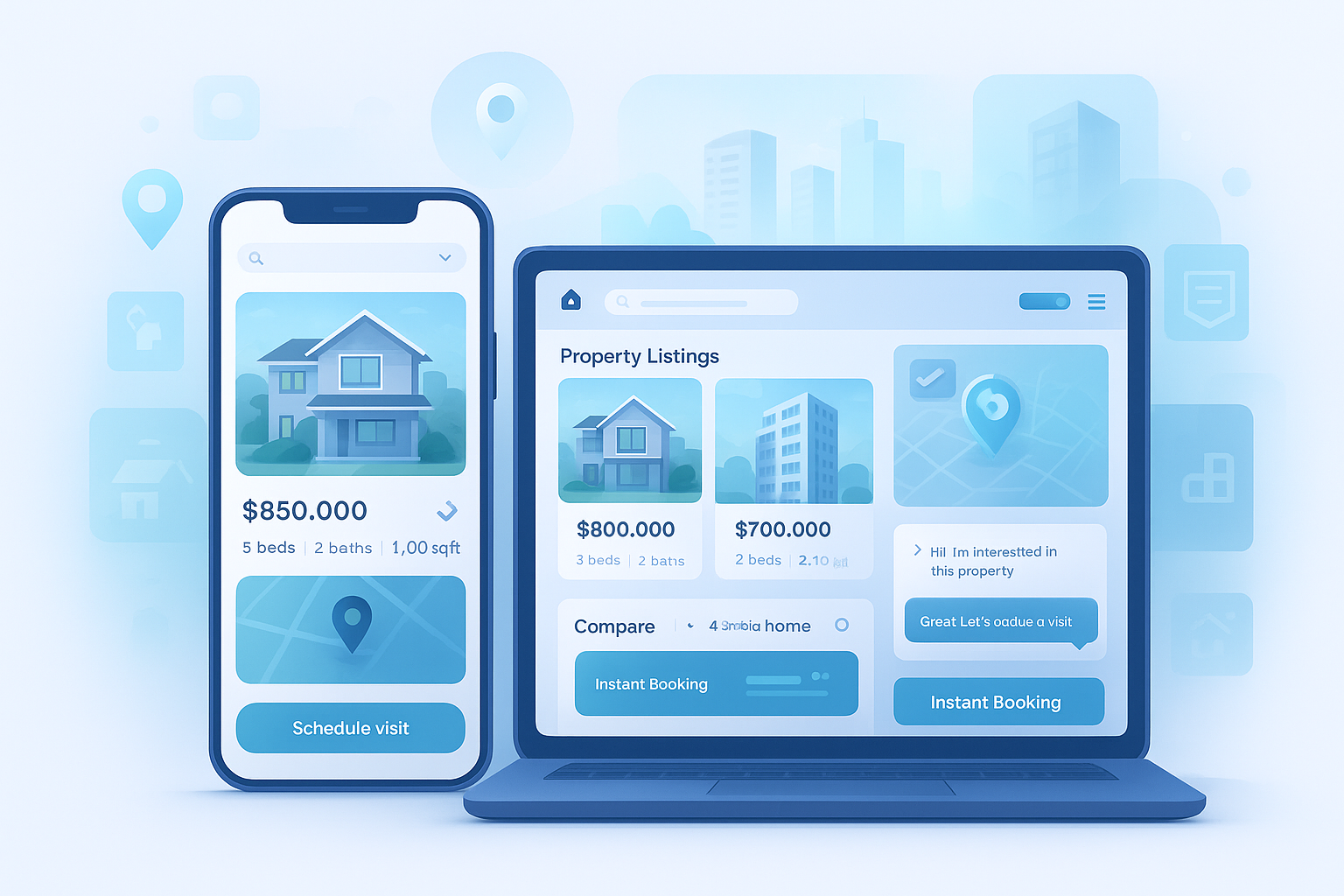
The Future of Real Estate Buying & Selling Marketplaces — A Deep Dive into Building the Next Property Tech Giant in 2025
Real estate isn’t just an industry — it’s a global economic engine. Yet, it remains one of the least digitized, most fragmented, and most paperwork-heavy sectors even today.
The rise of Real Estate Buying/Selling Marketplaces is transforming this reality. These platforms are becoming the backbone of property discovery, verification, negotiation, and transactions.
But building one is far from simple. You’re not just making a listing portal — you’re creating a complete, trust-driven transaction ecosystem.
This expert-level blog breaks down how modern real estate marketplaces work, where the industry is heading, and what it takes to build a platform that can scale like 99acres, Zillow, MagicBricks, Redfin, or NoBroker.
1. The Real Estate Market Is Ripe for Disruption
Traditionally, property buying is dominated by:
Local brokers
Offline networks
Physical site visits
Manual paperwork
Unstandardized pricing
Limited transparency
This creates inefficiencies such as:
Information asymmetry (buyers rely on agents’ knowledge)
Opaque pricing
High brokerage fees
Fraudulent or duplicate listings
Slow legal processing
A marketplace eliminates these barriers by becoming the single digital source of truth—the place where buyers, sellers, agents, and service providers converge.
2. What Defines a Modern Real Estate Marketplace?
Today’s real estate platforms are not just listing websites. They function as:
✔ Discovery Engine
Advanced filters, geospatial search, neighborhood intelligence.
✔ Trust Engine
Verified listings, ownership documents, legal checks.
✔ Transaction Engine
Negotiation tools, offer management, escrow, digital payments.
✔ Service Ecosystem
Loans, inspections, interior design, movers, insurance.
✔ Analytics Platform
Price predictions, demand heatmaps, ROI calculators.
A true marketplace removes friction at every step of the property lifecycle.
3. Core Modules of a High-Performance Real Estate Marketplace
A. Buyer Module
Smart search with 40+ filters
AI-powered recommendation engine
3D & VR property walkthroughs
Verified property badges
Neighborhood insights (schools, crime, transport, pricing trends)
Compare multiple properties side-by-side
Save & track listings
Instant chat with sellers/agents
Loan pre-approval & EMI calculators
B. Seller Module
Guided listing creation
AI-assisted price estimator (market comps + sentiment data)
Heatmap of buyer interest
Visibility analytics: impressions, views, inquiries
Auto-generated property brochures
Lead management dashboard
Appointment scheduling & viewing calendar
C. Agent Module
Multi-property management
Client tracking
Automated follow-ups
Priority listing promotions
Real-time communication suite
CRM integrated with marketplace leads
D. Admin Module
Fraud detection engine
Listing verification tools
Dispute management
Revenue dashboards
Service provider onboarding
Risk and compliance workflows
4. Advanced Tech That Will Power Real Estate Marketplaces in 2025
1. AI-Powered Pricing & Prediction
Demand forecasting
Automated valuation model (AVM)
Price negotiation suggestions
Under-construction project risk analysis
2. Blockchain for Property Records
Tamper-proof title verification
Smart contracts for buying/selling
Authentication of ownership transfers
3. AR/VR Digital Touring
Virtual site visits
VR staging (furniture visualization)
Accurate 3D floor plan transformation
4. Geo-Intelligence
Live property value heatmaps
Location-based ROI projections
Future infrastructure impact predictions
5. End-to-End Digital Transactions
Escrow accounts
e-Stamping & e-Signatures
Digital KYC
Instant payment tracking
A marketplace that integrates all these becomes irreplaceable.
5. Revenue Models for a Scalable Real Estate Marketplace
A strong marketplace never depends on only one income stream.
1. Listing Fees
Premium listing categories, highlighted ads.
2. Transaction Commission
Percentage on finalized deal.
3. Subscription Plans for Brokers & Builders
CRM tools, ads, insights, lead boosts.
4. Lead Selling to Sellers/Agents
Verified buyer inquiries.
5. Ancillary Services Commission
Home loans
Interior design
Legal documentation
Movers
Home insurance
6. Featured Developer Campaigns
Paid brand promotions.
7. Marketplace Insurance & Escrow Fees
A real estate marketplace can easily generate 8–12 revenue streams when built correctly.
6. Challenges — And How Top Marketplaces Solve Them
1. Fake or Duplicate Listings
Solution: Multi-step verification (documents + postal address + owner video).
2. Trust Building
Solution: Verified owners, verified agents, escrow transactions.
3. High CAC (Cost of Customer Acquisition)
Solution: Organic SEO, locality guides, social content, referral rewards.
4. Legal & Compliance Issues
Solution: Built-in legal partners + automated compliance checks.
5. Liquidity Problem (Not Enough Buyers or Sellers)
Solution: Target micro-markets → expand → scale.
7. How a Successful Marketplace Scales
The growth of property marketplaces follows a predictable pattern:
Start with a niche (ex: rentals, student housing, luxury homes)
Build trust through verified listings
Introduce transaction workflows
Add service partners (loan, inspection, movers)
Expand to nearby cities
Launch builder partnerships
Implement AI-driven pricing and prediction engines
Add international investors or NRIs
Within 12–24 months, this snowballs into a complete real estate ecosystem.
8. The Future: Transaction Marketplaces Will Replace Classified Platforms
The shift is already happening:
Old Model → Listing Website
New Model → Transaction Marketplace
Tomorrow’s winners will be platforms that offer:
Verified inventory
Real prices
Complete documentation
Digital payments
End-to-end support
The more friction you remove, the faster the marketplace grows.
Conclusion
A Real Estate Buying/Selling Marketplace is not just a platform —
it is a full-scale digital ecosystem that synchronizes:
✔ discovery
✔ verification
✔ conversation
✔ negotiation
✔ documentation
✔ payment
✔ post-purchase services
With the right technology, trust systems, and revenue strategy, a marketplace can easily become a multi-million-dollar PropTech business in under two years.