Building an AI Brand Identity Builder: The Ultimate Founder’s Guide (2025 Edition)
A Deep-Dive Into Technology, Strategy, Product Architecture, Monetization, and Growth
Introduction: The New Age of Automated Branding
Branding has always been a cornerstone of business success. For decades, companies relied on agencies, creative directors, and design teams to build a strong brand identity. While this worked for large enterprises, most startups, small businesses, and personal creators couldn’t afford such professional brand-building services.
Fast forward to 2025, and the landscape has transformed dramatically.
AI is now capable of:
Designing logos
Generating color palettes
Suggesting perfect font pairings
Understanding brand tone & personality
Building brand guidelines
Creating social media design systems
Producing ready-to-use brand kits
This shift has given birth to one of the highest-potential SaaS categories: AI Brand Identity Builder Platforms.
These platforms democratize branding—making high-quality brand identity accessible to anyone, at any budget.
This blog is a complete founder-oriented playbook for building, launching, scaling, and monetizing a world-class AI Brand Identity Builder.
1. Understanding the Concept
An AI Brand Identity Builder is a SaaS tool that takes minimal inputs from the user:
Brand name
Tagline
Industry
Target audience
Brand personality
Preferences (minimal, luxury, playful, bold)
Additional inspirations (images or styles)
… and instantly generates a full branding package with:
Logo options
Color palettes
Typography systems
Layout & design styles
Iconography & shapes
Brand voice guidelines
Mood boards
Social media kits
Brand guidelines PDF
Business card designs
Presentation templates
Website hero visuals
Think of this system as a branding agency powered entirely by AI, available instantly, globally, and at 1% of the cost.
The demand is huge. The opportunity is massive.
And the competition is growing—but still in its early stages.
2. Market Opportunity: Why AI Branding Is Exploding
2.1. The New Branding Landscape
Traditional branding is:
Slow
Expensive
Subjective
Dependent on designer skills
Hard to scale
AI, in contrast, provides:
Instant results
Very low cost
Consistency
Endless variations
Global availability
Data-driven decisions
Startups are being launched every day. Creators are building personal brands. Small businesses are moving online. D2C brands are scaling rapidly.
All these groups need brand identity, but they lack the budget and time to work with human agencies.
AI platforms solve this perfectly.
2.2. The TAM (Total Addressable Market)
The branding and creative design market size is valued at $55+ billion globally. AI design tools already crossed $4.7 billion and are forecasted to grow exponentially.
Segments driving demand:
Entrepreneurs
Dropshippers
E-commerce brands
Personal brands
YouTubers & creators
Freelance designers
Marketing agencies
Digital marketers
D2C and retail brands
Edtech & service startups
Even a small slice of this market can generate millions in recurring revenue.
3. How an AI Brand Identity System Works (Full Workflow)
3.1. User Input Phase
The user provides essential details:
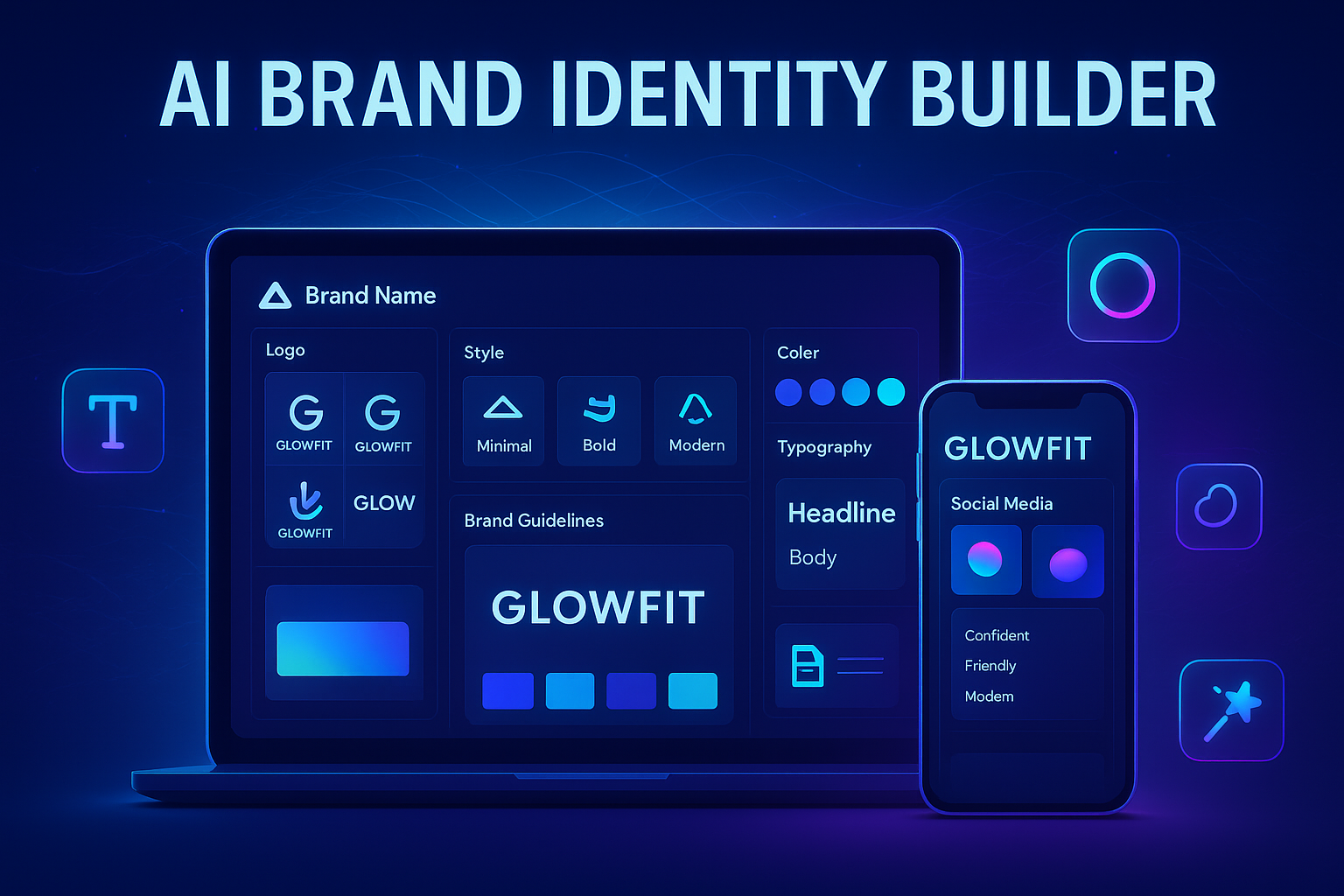
Brand name (e.g., “GlowFit”)
Tagline (optional)
Industry (Fitness, Fashion, Tech, etc.)
Brand personality (minimal, bold, luxury, playful)
Target audience
Preferred colors/shapes/fonts (optional)
Inspiration images (optional)
Your AI should analyze these inputs to determine:
Emotional tone
Industry trends
Competitor brand identities
Suitable visual language
Color psychology
Typography aesthetics
3.2. AI Processing Layer
The system performs:
NLP-based brand personality profiling
Logo generation using fine-tuned diffusion models
Color palette creation using color theory models
Font pairing recommendation using rule-based + AI heuristics
Layout composition using generative models
Voice & tone generation using LLMs (brand messaging)
Guideline structuring using template engines
3.3. Output Phase
After processing, the system generates:
A. Logo Variations
Minimal line logos
Wordmark logos
Icon + text combinations
Geometric logos
Pattern-based graphics
Mascot/illustration logos (optional)
B. Color System
Primary palette
Accent palette
Background colors
Gradients
Contrast & accessibility variations
C. Typography Pairings
Heading fonts
Subheading fonts
Body text fonts
Display/creative fonts (optional)
D. Brand Voice Recommendations
Tone keywords (e.g., confident, friendly, premium)
Messaging style
Tagline variations
E. Social Media Templates
1080×1080 post
Story format
LinkedIn banner
YouTube banner
Profile picture
F. Brand Guidelines PDF
A full professional document covering:
Logo rules
Colors
Fonts
Usage examples
Icon styles
Moodboard
Dos & Don’ts
This is often a premium export option.
4. Key Features Your Platform Must Include
4.1. Core Features (Stage 1 MVP)
1. AI Logo Generator
Uploadable inspirations
Style presets (Modern, Minimal, Corporate, Luxury, Playful)
Unlimited regenerations
2. AI Color Palette Engine
Based on psychology & industry trends
Harmonious palettes
Contrast-checked for accessibility
3. Typography Generator
Professional font pairings
AI-based font style suggestions
4. Brand Kit Generator
Logo files
Color codes
Typography system
Brand voice
5. High-Resolution Downloads
PNG
Transparent PNG
SVG (premium)
PDF (premium)
4.2. Advanced Features (Stage 2 Premium)
6. Social Media Brand Kit
Auto-generated templates
Matching brand colors
Logo placements
Ready-to-use assets
7. Business Card Generator
Based on brand identity
Easily editable
8. Brand Guidelines PDF Generator
Automatically formatted
Includes all brand assets
Fully editable or locked PDF
9. AI Brand Voice Builder
Taglines
Slogans
Social media bio
Mission/vision statements
10. Illustration Pack Generator
AI creates branded illustrations matching the brand’s style.
4.3. Enterprise & Scale Features (Stage 3)
11. Team Collaboration
Shared projects
Real-time editing
Approval workflows
12. White-Label License for Agencies
Agencies can resell your engine as their own.
13. API for Developers
Let other apps generate branding.
14. Asset Management System
Store and organize all brand files.
5. The Technology Behind an AI Branding Platform
Building this system requires multiple technologies integrated together:
5.1. Front-End Stack
React or Next.js – fast, scalable UI
Tailwind CSS – efficient styling
Framer Motion – animations
Konva.js / Fabric.js – for the editor
Your UI must feel premium, smooth, and visually elegant.
5.2. Backend Stack
Node.js / Python (FastAPI) – API layer
PostgreSQL / MongoDB – database
Redis – caching
AWS/GCP/Azure – infrastructure
5.3. AI Models Required
1. Logo Generation
Fine-tuned Stable Diffusion
ControlNet for shape consistency
StyleGAN for specific styles
2. Color Generation
Custom-trained color psychology model
Pantone-inspired dataset
3. Typography Engine
Rule-based font harmony
ML ranking model
Web-safe + premium fonts
4. Brand Guidelines Generator
Template engine
LLM-based content generator
5.4. Storage & File Management
You’ll need:
S3 buckets
CDN for fast delivery
GPU servers for model execution
6. Revenue Models (Highly Profitable in SaaS)
1. Monthly Subscription Plans
Basic: ₹299–699
Pro: ₹999–1499
Agency: ₹2999–6999
2. Pay-Per-Brand Kit
₹499–₹2999 per download
3. Brand Guidelines PDF (Upsell)
₹199–₹999
4. AI Illustration Packs
Recurring revenue
5. API Usage Fees
For developers & SaaS companies
6. White-Label Enterprise Licensing
High-ticket income
7. Template Marketplace
Sell premium templates, icons, illustrations.
7. Marketing Strategy: How to Acquire Users Fast
You must market visually because branding is visual.
Here’s the winning playbook:
7.1. Organic Marketing
1. Instagram & LinkedIn
Showcase brand identity transformations
before/after AI branding
Reels of logo generation
Carousels of color palettes
2. YouTube
Create content like:
“Brand Identity in 30 Seconds with AI”
“How AI Designs Better Than Humans”
3. SEO
High-intent keywords:
AI brand kit
brand identity generator
online logo maker
generate color palette
4. Pinterest
Mood boards, palettes, templates.
7.2. Paid Ads
Google Ads (branding keywords)
Facebook/Instagram visuals
YouTube pre-roll for entrepreneurs
7.3. Partnerships
Work with:
Startup incubators
Design agencies
E-commerce platforms
Influencers
7.4. Lead Magnets (Free Tools)
These build huge organic traffic:
Free color palette generator
Free logo ideas tool
Free brand name creator
8. Launch Strategy: Build → Test → Scale
Phase 1: MVP (2–3 months)
Logo generator
Color palette engine
Basic brand kit
PNG downloads
Phase 2: V2 (3–6 months)
Social media kit
Typography
PDF export
Phase 3: Scale (6–12 months)
API
Mobile app
Enterprise plans
9. 12-Month Growth Roadmap
Months 1–3
Build MVP
Collect early feedback
Train initial models
Months 4–6
Launch public beta
Add templates & social kits
Onboard agencies
Months 7–9
Brand guidelines PDF
Marketplace for templates
Global marketing
Months 10–12
Mobile app
API launch
Enterprise onboarding
10. Final Thoughts: The Future of AI Branding
AI is not just replacing designers—it’s empowering them.
The future branding world will be:
Faster
Smarter
More accessible
Fully data-driven
If you build an AI Brand Identity Builder today, you’re not entering a saturated field.
You’re entering a massive growth wave.
With the right execution, this can become a:
multi-million-dollar SaaS
global subscription business
high-margin software platform
The opportunity is huge.
And this is the best time to build it.