AI Medical Symptom Checker — The Complete Blueprint to Building a Game-Changing Healthtech Startup (2025 Edition)
In 2025, one of the fastest-growing healthtech opportunities is the rise of AI-powered medical symptom checkers.
Why?
Because healthcare is broken in predictable ways:
Patients Google symptoms and panic.
Clinics are overloaded.
Early diagnosis is rare.
Doctors spend time on repetitive triage tasks.
Rural areas lack medical access.
And this is where AI steps in — not to replace doctors, but to support faster diagnosis, triage, and decision-making with unmatched efficiency.
If you’re planning to build an AI Medical Symptom Checker startup, this blog gives you the complete blueprint: product architecture, tech stack, workflow design, monetization, compliance, and go-to-market strategy.
Let’s dive in.
1. What Exactly Is an AI Medical Symptom Checker?
An AI Medical Symptom Checker is a digital tool that:
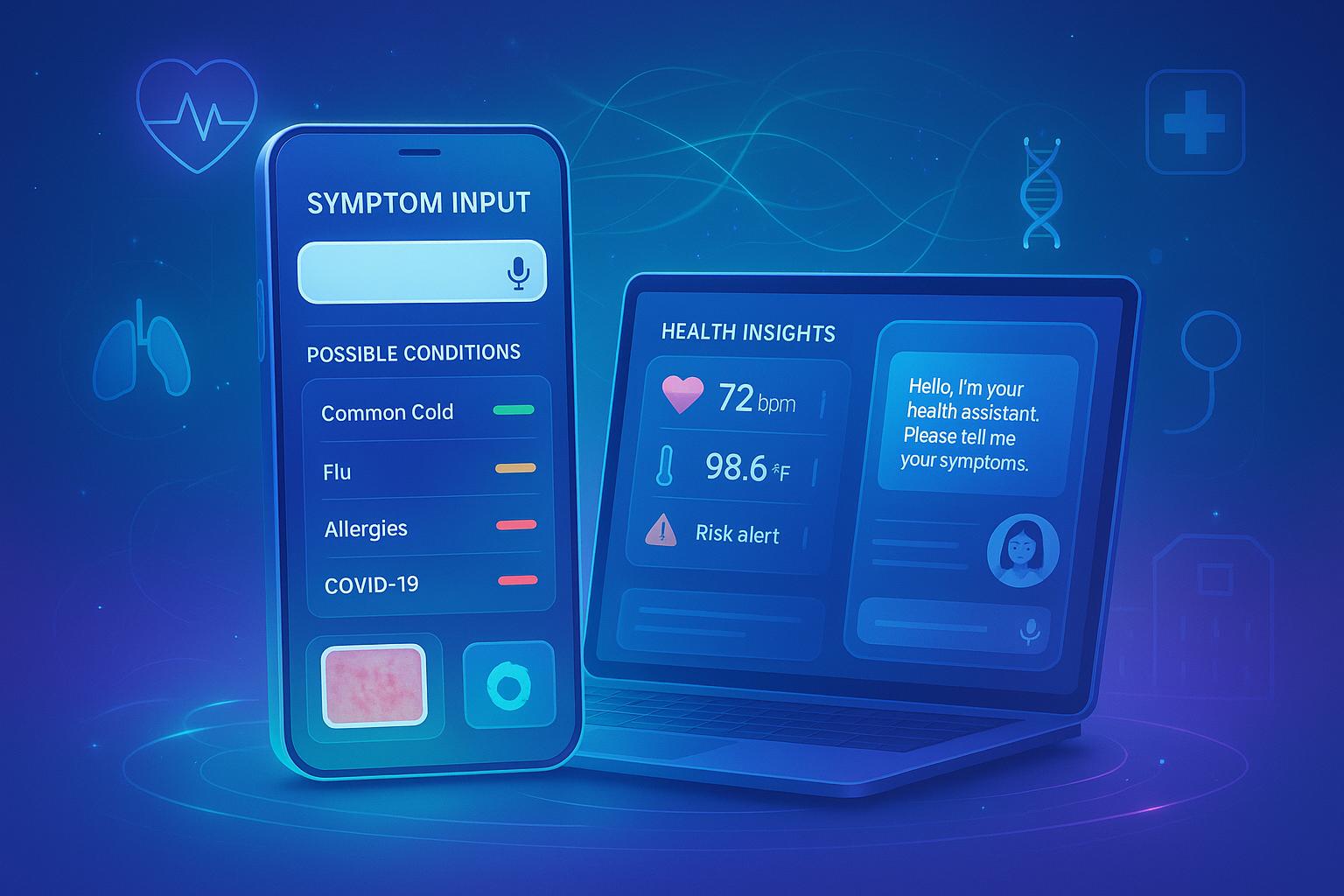
✔️ Takes symptoms entered by a user (text/voice/images)
✔️ Uses AI + medical datasets to analyze cause patterns
✔️ Suggests possible conditions
✔️ Recommends the next steps
✔️ Advises severity level (low/medium/emergency)
✔️ Connects users with doctors or hospitals
It functions like an AI-powered medical triage assistant — reducing uncertainty and offering quick, personalized guidance.
2. Why This Business Has Massive Market Demand (2025–2030)
🔥 Market Stats
Global AI healthcare market: $187+ billion by 2030
70% of patients search symptoms online before visiting a doctor
40–60% of hospital visits are non-emergency and could be pre-screened by AI
Telemedicine adoption is skyrocketing in India, UAE, US, Europe
🔥 Biggest Gaps You Can Solve
Lack of instant access to medical advice
Rural healthcare gaps
Overcrowded emergency departments
High cost of primary consultations
Self-diagnosis anxiety
You’re not building “just another app” — you’re building a life-saving tool at planetary scale.
3. How the Symptom Checker Works — Full Workflow
Step 1: User Inputs Symptoms
Methods:
Text-based input
Voice input
Questionnaire auto-generated by AI
Uploading images (rashes, wounds, eye redness, etc.)
Step 2: AI Processes the Input
The engine uses:
NLP medical models
Symptom-to-disease mapping
Real clinical datasets
Probability scoring
ICD-10 medical classification
Step 3: AI Generates Outputs
Outputs include:
Likely possible conditions
Severity level (Low → Critical)
Recommended action (Rest / Medication / Visit GP / Emergency care)
Home care suggestions
Red-flag warning signs
Step 4: AI Offers Follow-Up Services
Connect with telemedicine doctors
Book lab tests nearby
Provide personalized health plans
Track symptoms over time
Offer re-check after 24–48 hours
4. Core Features Your Platform Must Have
1. AI Symptom Input Engine
Free text, voice, and guided form
Multi-language support (India: Hindi, Odia, Bengali, Tamil, Telugu, etc.)
2. Medical Knowledge Graph
A structured database connecting:
Symptoms
Diseases
Causes
Risk factors
Treatments
Emergency situations
3. AI Triage & Severity Scoring
Categorizes urgency:
Green: mild
Yellow: moderate
Orange: urgent
Red: emergency
4. Telemedicine Integration
Video consultations
Chat-based doctors
Specialist recommendations
5. Medical Device Integrations
Optional but powerful:
Wearables
Heart rate monitors
Glucose trackers
Smart thermometers
6. Smart Health Dashboard
For users to track:
Symptoms
Trends
Reports
Recommendations
7. Pharmacy Integration
Auto-suggest OTC medicines (where legally allowed)
Order medicines online
Share prescription digitally
5. Technology & Architecture — How to Build the AI Engine
A. AI & ML Technologies
NLP (Natural Language Processing)
Medical LLMs
RAG (Retrieval Augmented Generation)
Bayesian prediction models
Multi-modal models for image recognition
B. Data Required
Medical textbooks
Clinical symptom datasets
WHO datasets
ICD-10 datasets
Dermatology image datasets
Expert-verified diagnosis data
C. Backend Architecture
Frontend (App + Web)
API Gateway
AI Processing Layer
Medical Knowledge Graph Database
Triage Algorithm Engine
Doctor/Telemedicine System
Analytics & Monitoring
D. Ideal Tech Stack
Frontend: React, Next.js, Flutter
Backend: Node.js, Python (FastAPI)
AI: PyTorch, TensorFlow, OpenAI models, HuggingFace models
Database: MongoDB + Neo4j (knowledge graph)
Cloud: AWS / GCP / Azure
6. Legal, Compliance & Safety Requirements (Very Important)
Medical Regulation Areas
Medical AI falls under “clinical decision support systems”
Must follow local health laws:
India → NDHM, Ayushman Bharat Digital Mission
US → HIPAA
EU → GDPR
UK → NHS Guidelines
Gold Standard Compliance
✔️ Data privacy & encryption
✔️ Disclaimer: Not a medical diagnosis
✔️ Human review for high-risk predictions
✔️ Emergency alerts
You must show:
Transparency
Explainability
Safety monitoring
Bias & error control mechanisms
7. Monetization Models — 11 Revenue Streams
1. Freemium App + Paid Premium
Basic symptom checks are free
Premium features unlocked (Rs. 99–299/month)
2. Telemedicine Commission
Earn on consultations via:
General physicians
Dermatologists
Nutritionists
Specialists
3. Pharmacy Partnerships
Commission on:
Medicines
Wellness products
4. Diagnostics/Lab Tests
Earn on:
Blood tests
Full-body checkups
Scans (X-ray, MRI)
5. Corporate Health Plans
Sell B2B wellness tools to:
Offices
Schools
Hospitals
Insurance companies
6. API Licensing to Hospitals
Hospitals can embed your AI checker into their systems.
7. White-label SaaS Model
Sell your entire platform to:
Clinics
Governments
Health startups
8. Insurance Integration
Predictive risk scoring partners with insurers.
9. Wearable Device Integrations
Partner with smartwatch companies.
10. Ads (ethical/limited)
For health products only.
11. Emergency Service Partnerships
Ambulance booking + urgent care centers.
8. Go-to-Market Strategy (GTM)
Phase 1 — Build Trust
Create medical content
Educate the audience on symptom checking
Partner with doctors & hospitals
Phase 2 — Launch MVP
Start with 5–10 disease areas
Focus on accuracy and safety
Phase 3 — Scale
Add multilingual support
Add dermatology AI
Integrate telemedicine
Expand to rural India
Phase 4 — Brand Positioning
Position as:
“Your 24/7 AI Health Assistant — Instant, Reliable, Safe.”
9. Competitive Landscape — And How You Can Win
Existing Players
Ada Health
WebMD
Buoy Health
Practo (limited checker)
Apollo (India-based triage)
Your Edge
More localized content
Multilingual AI
Stronger telemedicine integration
Trust-building medical partnerships
Real-time image-based diagnosis
10. Future Expansion Opportunities
AI nutrition planner
AI mental health evaluator
AI women’s health assistant
Wearable-based disease prediction
Full AI doctor (regulated environment)
Global decentralized health data system
The future of healthcare is predictive, personalized, and always-available — and your startup can lead this revolution.